Internal documentation return rate
Unique claims returned due to a confirmed documentation issue / unique claims audited in the period × 100.
Internal metric; not equivalent to the payer's denial rate. Report sample size and selection.

Explore Tervali topics
No topics found. Try “processes”, “Caremap” or “training”.
Clinical management and billing
How to reduce duplicate documentation, audit the causes of claim denials, and track documentation quality with metrics, accountable owners, and a verifiable process.

Preventing documentation-related claim denials requires reliable records and reconciliation between clinical care, audit, and billing. The first step is to locate where open issues originate and eliminate redundant transcription, while preserving authorship, context, and traceability.
A piece of information may pass through paper, the health record, and a spreadsheet before it reaches the hospital bill. When each step requires re-entry, opportunities for discrepancies arise, along with time spent checking versions. The institution needs to find out at which step the information originates, who validates it, and why another department needs to record it again. Automating transcription without answering these questions may only speed up the circulation of inconsistent data.
This article examines two operational pain points: time-consuming, duplicate documentation, and incomplete or denied claims. The proposal is a management method to test locally, without estimating savings in advance. Documentation quality should support continuity of care and make it possible to understand the care provided. Whether a service can be billed also depends on authorization, contract, coding, and other requirements; adequate documentation does not guarantee payment.
COFEN Resolution 736/2024 (from Brazil's Federal Nursing Council) requires formal documentation of the Nursing Process in the paper or electronic health record and distinguishes the responsibilities of registered nurses from those of other team members. Nursing diagnosis and nursing orders are exclusive responsibilities of the registered nurse. Simplifying screens requires preserving this division of responsibilities, without turning all documentation into a generic checkbox. [1]
COFEN Resolution 754/2024 covers records and digital systems and revoked Resolution 429/2012. The Code of Ethics, approved by Resolution 564/2017, requires the information needed for care to be clear, complete, and in chronological order. [2][3] When reviewing a form, the useful question is which clinical decision each field supports. An additional financial field needs its own purpose and owner; it must not alter the true description of the care provided.
Start by following a sample of claims from the encounter through the first billing review. Include accepted and returned claims, different shifts, and different types of encounter. Define the period and selection criteria before looking at the results. A sample made up only of problem claims reveals failures, but does not allow you to estimate how often those failures occur across total volume.
For each repeated piece of information, record its origin, destination, the professional involved, approximate time, and the stated reason for the repetition. Distinguish unnecessary copying from a review with a clinical purpose. Confirming a current condition is not the same as transcribing an administrative data point. If a spreadsheet receives information from the health record because another department cannot access it, investigate permissions and available reports before building an integration. The solution may lie in how access and data ownership are organized.
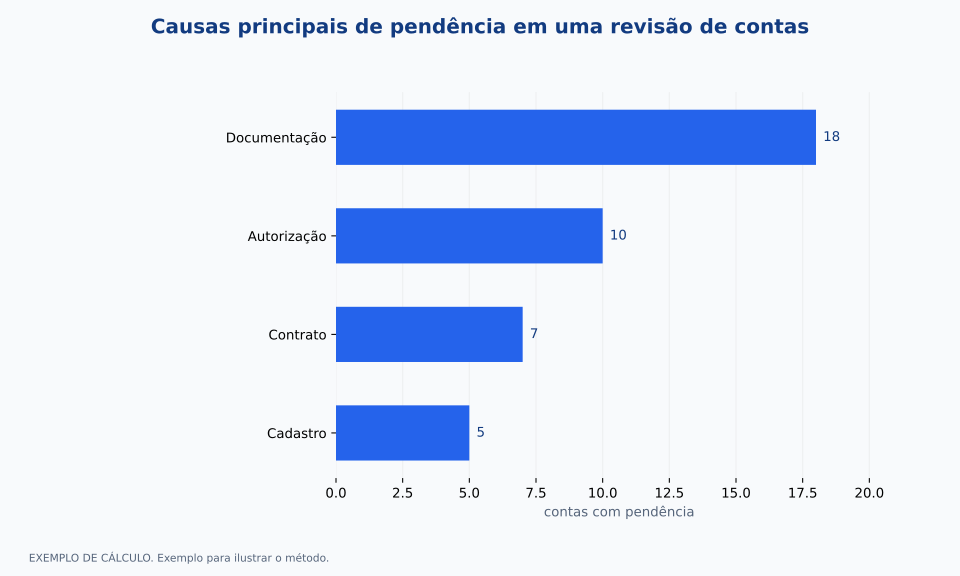
Example of 100 claims reviewed: 40 with an issue and 60 with no issue identified. Each of the 40 receives only one primary cause. The values do not represent denials actually applied.
| Category | claims with an issue |
|---|---|
| Documentation | 18 |
| Authorization | 10 |
| Contract | 7 |
| Registration | 5 |
Process map for discussing responsibilities and handoff points with your teams. Adapt it to your institution’s context.
Clinical team: contemporaneous account and attribution of authorship.
Audit and billing: check evidence, line items, and applicable requirements.
Originating department: clarify the discrepancy with traceability; return to reconciliation.
Billing: transmit the claim and keep the submission record and response.
Audit and finance: validate the reason, appeal, and payment received.
Department managers: revise the form or rule and monitor recurrence.
A denied claim may involve missing evidence of care, a quantity mismatch, an incompatible authorization, a contract rule, or a registration error. These classes are an analysis taxonomy proposed here, to be adapted to each service. Avoid logging everything as a nursing failure. The reason received from the payer should be preserved and linked to the internal root-cause hypothesis, which requires documentary verification.
In Brazil's private health insurance sector, the TISS Standard organizes the exchange of information among participants. Consult the components published by ANS, the national private health insurance regulator, and the version that applies to the submission. [4] Separate the code received from the payer, the audit analysis, the person responsible for action, and the outcome of the appeal. A denial initially attributed to documentation may end up recognized as a contract discrepancy; keep the history of that review so you do not train the team on the wrong cause.
The proposed process starts with care and its documentation, moves on to reconciling claim line items, and ends with structured feedback on discrepancies. The clinical team documents what actually happened. Audit and billing check consistency, supporting documentation, and applicable requirements. Each open issue receives an owner, an internal deadline, and a resolution criterion. The map below represents this sequence and should be adjusted to the roles that exist in the institution.
When a discrepancy is found before submission, the feedback must state the problem precisely: which event, which piece of information, and which evidence is available. Vague requests to complete the chart generate more back-and-forth. A later clarification must follow the institutional correction procedure, preserve authorship, and distinguish the time of the event from the time of documentation. No one should invent care that was not performed or retroactively change the account to make the claim appear eligible.
A useful integration carries data with context: encounter identifier, origin, time, author, and validation status. In the operational design, define which system is responsible for each piece of information and how an update reaches the others. Test prescription changes, cancellations, returns, and system downtime. An integration that only works on the usual path can generate duplicate charges precisely in the exceptions.
Structured forms help locate information, but too many mandatory fields encourage automatic answers. Test usability with professionals from different shifts and leave room for relevant specifics. Reusing registration data does not mean copying a previous assessment as if it were current. Resolution 754/2024 sets requirements for electronic records and signatures; the possibility of going paperless requires analyzing the conditions set out in the regulation and does not follow simply from having a login. [2]
Track one documentation process measure, one effort measure, and one financial outcome measure. The first shows the share of claims returned due to a confirmed documentation issue. The second records minutes of rework per audited claim. The third tracks amounts denied and recovered by billing period. Publish numerators, denominators, and the follow-up window; recent claims may not yet have been reviewed or had an appeal decided.
The chart presents an example: of one hundred claims reviewed, forty had some issue, each classified by a single primary cause. Eighteen are documentation, ten authorization, seven contract, and five registration. The other sixty had no issue identified. These numbers show how to segment the problem. If documentation improves, other causes may continue to produce denials. A reduction in internal returns also does not automatically equal recovered revenue.
Choose one unit and one claim type with enough volume for observation. Record the baseline, revise one form or one specific duplication, and track the same metrics afterward. Agree on who reviews questions and who decides on process changes. Compare periods with similar case mix and billing rules, noting any staff, contract, or system changes that could explain differences in results.
The expected result of the pilot is evidence for a decision: keep, adjust, or abandon the change. Check whether rework went down without losing necessary information, delaying care, or piling tasks up at the end of the shift. Operational analysis does not replace clinical judgment, technical audit, or contract review. The concrete next step is to choose one recurring issue, reconstruct its path, and test a fix at the source with nursing, audit, and billing.
Check off the items already in place. Use the rest as a working agenda.
Unique claims returned due to a confirmed documentation issue / unique claims audited in the period × 100.
Internal metric; not equivalent to the payer's denial rate. Report sample size and selection.
Sum of observed minutes spent locating, reconciling, or correcting information / audited claims, including those with no rework.
Record the observation method and separate active time from waiting time; do not use for individual rankings.
Amount initially denied with a confirmed documentation cause / amount billed for the same claims in the billing period × 100.
Report the maturity of the billing period and attribution rules when there are multiple causes.
Amount actually received after appeal / documentation-related amount appealed in the same cohort × 100.
Track only cohorts with a stated decision window; an approved appeal without payment is not yet cash recovery.
A conversation in Portuguese on the key points of the article and its references.
Download episodeIt can reduce documentation-related issues, but denials also involve authorization, registration, and contract rules. The contribution must be measured by confirmed cause and for the same cohort of claims.
It depends on the purpose of each document and on the system's technical and regulatory conditions. COFEN Resolution 754/2024 sets specific requirements; scanning or using a password is not enough to assume that any record can skip printing. [2]
Choose one repeated piece of information, follow its path, and check why each department needs it. Remove a transcription only after confirming access to the source, context, and responsibility for updates.
Primary sources used to produce this content. Implementation recommendations should be adapted and validated by each institution.
Articles 6 to 8: responsibilities and formal documentation of the Nursing Process.
Records on paper or electronic media, system and signature requirements, conditions for skipping printing, and revocation of Resolution 429/2012.
Articles 36 to 38: quality, documentation, and continuity of clinical information.
Interoperability purpose and official access to the standard's components and versions. The chart figures are a worked example, not a national denial rate.
Educational content on management and technology. It does not replace professional judgment, current regulations or clinical protocols.
KEEP EXPLORING