Handoff completeness (%)
100 × handoffs with all minimum fields ÷ audited handoffs.
Fix the fields and audit unit. Completing fields does not prove understanding.

Explore Tervali topics
No topics found. Try “processes”, “Caremap” or “training”.
Nursing management
How to structure the nursing shift handoff, track open items, and organize requests, with a process map, checklist, and operational metrics.

A structured handoff links changes, risks, and open items to accountable people who confirm their understanding. Up-to-date documentation, a channel for requests, and completion criteria support follow-through.
A shift change can end with everyone informed and still leave a care task without follow-up. This happens when hearing about an open item is mistaken for taking ownership of it. The decisive operational question is: who follows up on the next action, by when, and how will the team know it happened?
This article covers three connected problems: incomplete shift handoffs, interruptions and scattered requests, and open care tasks without follow-up. The goal is to organize nursing work without turning the conversation into a full read-through of the chart. The workflow and metric proposals below are operational adaptations for institutional review, not clinical orders or a promise to reduce adverse events.
AHRQ describes the handoff as a structured transfer of information, authority, and responsibility. Its material emphasizes recent changes, uncertainties, the plan of care, contingencies, and the opportunity to ask questions, with acknowledgment by the receiver. This guidance helps evaluate the handoff by the understanding achieved, not just by whether a form exists. [1]
In practice, consider three questions per patient: what has changed since the last assessment, what needs attention in the next period, and what is still open? The context should make the priority of each open item clear. A long task list without that context can make different situations look equally urgent. Clinical content and decisions remain subject to professional judgment and institutional protocols.
SBAR organizes communication into situation, background, assessment, and recommendation or request. The official AHRQ tool includes stating explicitly what is needed and when, with a read-back of the response to confirm accuracy. It is a reference for structuring the conversation, not a guarantee that every risk will be identified. [2]
For the shift, select the information relevant to each situation and add a list of open actions. An example: an assessment has already been requested, the department has not yet confirmed it, and the receiving nurse needs to check for a response at the agreed time. The example shows how communication is organized, without defining care for any patient. At the close, the receiver summarizes priorities and clarifies discrepancies before taking over follow-up.
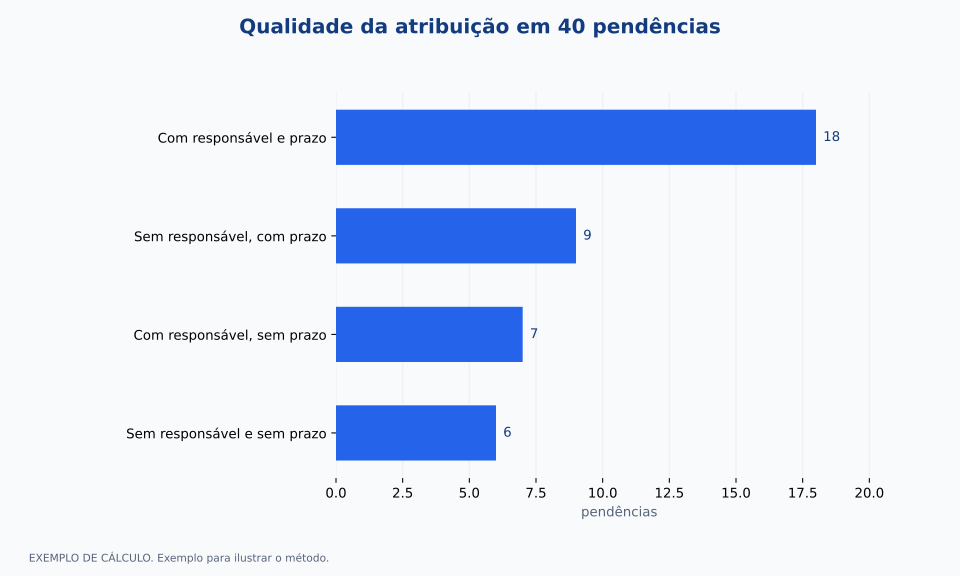
Mutually exclusive classification of 40 open items. 22 have some gap; this does not measure omission of care.
| Category | open items |
|---|---|
| With owner and deadline | 18 |
| No owner, with deadline | 9 |
| With owner, no deadline | 7 |
| No owner and no deadline | 6 |
Process map for discussing responsibilities and handoff points with your teams. Adapt it to your institution’s context.
Outgoing team reconciles documentation and actions.
Sender highlights changes and priorities.
Receiver asks questions and summarizes priorities.
Owners agree on follow-up and deadlines.
Incoming team reviews dependencies.
Record completions; reassess blockers and open items.
A useful operational tracking sheet contains a link to the encounter, the expected action, the source of the request, the accountable professional or team, the agreed deadline, and the current status. Suggested statuses: open, accepted, in progress, blocked, completed, or canceled with justification. A blocked status must state which dependency is preventing progress and who should be contacted. Assignments must respect professional scope of practice; agreeing to follow up on a dependency does not transfer another discipline's legal responsibilities.
Define what proves completion for each type of task. Calling a department may close the contact action, but not the pending assessment. COFEN Resolution No. 736/2024 (from Brazil's Federal Nursing Council) requires formal documentation of the Nursing Process in the paper or electronic health record and distinguishes entries by registered nurses from those by other team members. A tracking list should support that documentation, not replace it. [3]
Before choosing a tool, observe where requests come from: phone, hallway, system, and messages. Over a sample of shifts, record only the categories and times needed for the analysis. Check how many requests require a second search because no one knows who received them. This assessment distinguishes a missing channel, insufficient capacity, and interruptions caused by a real change in the patient's condition.
As a local proposal, set up an institutional intake point for non-urgent requests and a point person during handoff, as staffing allows. Emergencies follow the escalation process defined by the service and must interrupt routine when necessary. Afterward, the team reconciles what was left open. Protecting the handoff means reducing avoidable fragmentation, without creating a barrier to critical alerts or requiring anyone to wait in an administrative queue to ask for help.
The proposed map starts with updating documentation and reconciling open actions. Then come a prioritized summary, questions, confirmation, and an initial review by the incoming team. Each step must produce an observable output: a reviewed list, questions answered, or an owner assigned. If the conversation and the record disagree, flag the item for clarification, keeping the previous information until the correction is justified.
The handoff should also accommodate absences, unit transfers, and changes of owner mid-shift. In these cases, record who took over and when, using the institutional mechanism. If the system is down, use the approved downtime procedure and reconcile notes when it comes back. Avoid multiple independent copies that keep circulating after an update, especially when they include clinical information.
Measure the share of audited handoffs with the local required fields completed, open items with an owner and a deadline, and overdue items still open. Fix the time of data collection: for example, immediately after the handoff. Without that reference point, the same task can appear open in one collection and completed in another, producing a misleading comparison. The proposed formulas are in the metrics table.
Also track duration, interruptions by reason, and the team's perception of clarity. Shorter duration on its own may mean omission; more entries may mean better visibility. Separate missing fields, duplicate requests, external blockers, and legitimate changes to the plan. Do not use the raw count of open items to compare professionals with different workloads and acuity. Process metrics help investigate the work, but do not, on their own, demonstrate an effect on clinical outcomes.
The chart shows an example classification of 40 open items at shift change: 18 with an owner and a deadline, 9 without an owner, 7 without a deadline, and 6 without either. The categories are mutually exclusive. In this example, 22 of 40 items, or 55%, have at least one of these two gaps. This does not mean that 55% of care was omitted, since the sample describes only the quality of the recorded information.
Use this kind of breakdown to choose the first change. If missing owners predominate, review assignment and confirmation; if missing deadlines predominate, examine how they are agreed upon. Repeat the collection using the same definition and check whether better documentation corresponds to real follow-up.
Choose one unit and one frequent type of open item. Agree on the minimum fields with those who perform and those who receive the work, train on ambiguous situations, and do a baseline observation before the change. During the pilot, review a few items daily to check whether completion and confirmation mean the same thing to everyone. Scale up only when the workflow can represent exceptions without relying on additional informal instructions.
The next step is a joint review by nursing leadership, quality, and the teams involved: did the guide improve understanding, did the list duplicate documentation, and which blockers remain outside the unit's control? Staffing shortages, integration gaps, or another department's capacity cannot be solved with more fields. The expected output of this review is a specific process adjustment and a follow-up check, not a generic promise of error-free shifts.
Check off the items already in place. Use the rest as a working agenda.
100 × handoffs with all minimum fields ÷ audited handoffs.
Fix the fields and audit unit. Completing fields does not prove understanding.
100 × open items with an owner and a deadline or reassessment ÷ open items at handoff.
Zero denominator: not applicable. Separate owner gaps from deadline gaps.
100 × overdue open items ÷ open items with a deadline, at cutoff.
Show items without a deadline separately. Investigate blockers and legitimate changes.
Observed interruptions ÷ observed handoffs, by reason.
Keep the observation unit constant. Urgent alerts may be necessary.
A conversation in Portuguese on the key points of the article and its references.
Download episodeIt helps organize communication; responsibilities, confirmation, and follow-up are still needed. AHRQ presents SBAR and handoff as related tools. [1][2]
No. Formal documentation of the Nursing Process belongs in the health record, in line with the responsibilities set out in COFEN Resolution No. 736/2024. [3]
Identify who performs it and who follows up. Record the blocker, reassessment, and escalation, while respecting professional scope of practice.
Primary sources used to produce this content. Implementation recommendations should be adapted and validated by each institution.
Transfer of information and responsibility, acknowledgment by the receiver, questions, recent changes, and contingencies. Official material revised in May 2023, consulted live.
SBAR components, explicit request, and read-back of the response. Official material revised in November 2019, available in the curriculum consulted live; not a Brazilian regulation.
Formal documentation of the Nursing Process in the health record and team responsibilities, especially articles 6 to 8. Official text consulted live; does not establish the operational form proposed in this article.
Educational content on management and technology. It does not replace professional judgment, current regulations or clinical protocols.
KEEP EXPLORING