Launching a new healthcare service: check the opening conditions before promising a date
How to launch a specialty or occupational health line by building on what already exists: inventory, gaps, patient journey, costs, turnaround, and opening.
Tervali Editorial Team8 min read4 sources
THE STARTING POINT
A new healthcare service rarely starts from scratch: it starts with an inventory of what the hospital or clinic already has and a list of what is missing. The opening date should follow from verified criteria, not be a promise made before the gaps are known.
The request usually arrives in a hurry. A local employer wants to contract occupational health exams for its workforce, a physician wants to bring in a new specialty, leadership wants to expand a service that already runs. The next question is almost always the same: when can we start? Answering with a date before checking facilities, staff, workflow, costs, and turnaround commitments is the most common way to turn a good opportunity into delays, rework, and friction with the client.
This guide uses as an example the launch of an occupational health line inside a hospital: visits with an occupational medicine physician, audiometry, lab and imaging tests, and organizational psychology support. The same reasoning applies to other specialties. The recommendations are operational and do not replace reading the current regulations or guidance from the responsible clinical leads.
Start with an inventory, not a date
A midsize hospital or clinic almost always has much of what a new service needs: exam rooms, a front desk, a lab with a draw station, X-ray, and scheduling and billing systems. The first task is to list, requirement by requirement, what the new service demands and compare it with what exists. The comparison has to be concrete: it is not enough to say there is a lab; you need to know whether the draw station can handle more patients at the time of day employers want to send their workers.
The World Health Organization's service availability and readiness assessment, known as SARA, treats readiness as the availability of the components needed to deliver a service and measures service-specific readiness through tracer items such as trained staff, guidelines, equipment, diagnostics, and medicines. [4] The tool was designed for surveys of health systems, but the logic carries over to a new service: the question is not whether the hospital is good, but whether every component this service requires is available and working.
Check the formal requirements before announcing
For occupational health in Brazil, the starting point is NR-7, the regulatory standard for the Occupational Health Medical Control Program (PCMSO), which is tied to each employer's risk assessment under its Risk Management Program (PGR). The standard requires pre-employment, periodic, return-to-work, change-of-exposure, and exit exams, each made up of a clinical exam and supplementary tests, and an Occupational Health Certificate (ASO) issued for every clinical exam. [1] The employer is the one that contracts the PCMSO; the healthcare service must be able to perform the tests the program specifies.
Annex II of the same standard sets specific requirements for audiometry: an audiometric booth or acoustically treated room that meets ISO 8253-1, an annual acoustic check of the audiometer, periodic calibration, testing performed by a physician or audiologist, and at least 14 hours of auditory rest before the test. [1] Details like these determine the equipment, the room, the professional, and even the instructions given to the worker at scheduling.
Two other checks apply to any specialty. If the launch involves construction, expansion, or renovation, Anvisa's RDC 50/2002 requires the local health surveillance authority to review the physical design before work begins. [2] And Brazil's National Registry of Health Facilities (CNES) records the physical resources, workforce, and services of each facility, with mandatory updates whenever that information changes. [3] Regulations get revised; check the current text and the municipality's requirements before locking in the timeline.
THE PROCESS IN NUMBERS
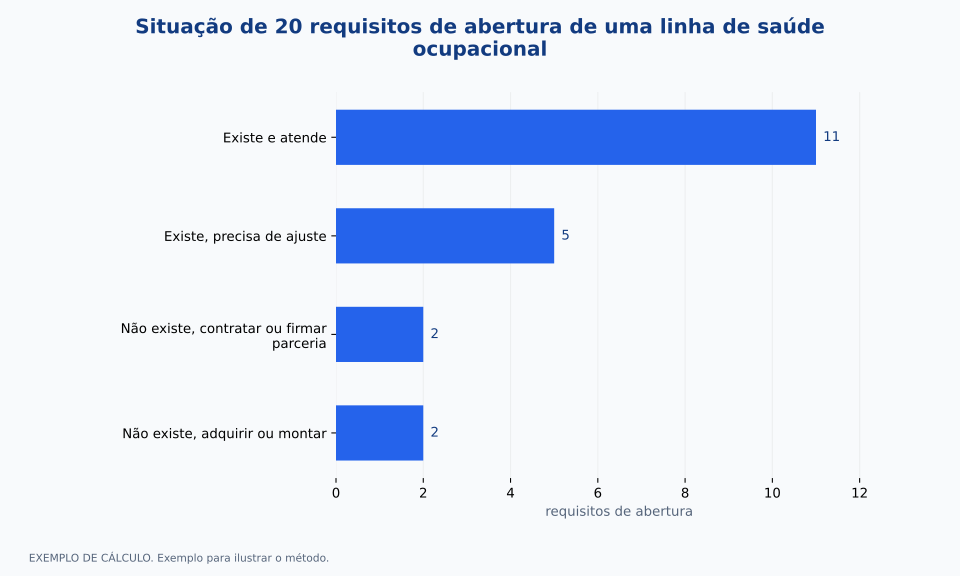
Status of 20 go-live requirements for an occupational health line
Example: 11 requirements already exist and meet the need; 5 exist but need adjustment; 2 require hiring or a partnership; 2 need to be bought or set up. Total: 20 requirements.
WORKED EXAMPLEExample to illustrate the method.
Comparison by go-live requirementsChange the values to explore a scenario.
Once the inventory is done, each requirement gets one of the four classifications below. The classification matters because each type of gap has a different timeline, cost, and owner. Adjusting a schedule takes days; hiring a professional or buying equipment can take months.
Exists and meets the need: requirement available, with evidence such as a contract, certificate, or staffing schedule.
Exists, needs adjustment: resource available, but with hours, capacity, or workflow that do not fit the new service.
Does not exist, hire or partner: a professional or service that makes sense to bring in from outside.
Does not exist, buy or build: equipment, a room, or a tool that has to be purchased or set up.
Map the journey of the people you will serve
An occupational health service has two clients: the employer, which schedules and pays, and the worker, who shows up. Map the worker's journey from scheduling to delivery of results: how the employer sends the list of tests specified in the PCMSO, where the worker checks in, in what order they go through the draw station, X-ray, audiometry, and the physician visit, and who pulls everything together so the physician can issue the certificate. A poorly planned sequence sends the worker back to the front desk twice or has them wait for audiometry after hours in a noisy environment.
The journey also shows where the new service competes for capacity with the existing one. If all the workers arrive at seven in the morning, the draw station and X-ray that serve outpatient and inpatient care get an extra peak. Holding time windows for the new line is a scheduling decision that has to be made before opening, together with whoever runs those departments.
Lock in partners, costs, and pricing assumptions with finance
Partnerships, such as organizational psychology or audiology, need scope, a responsible clinical lead, a scheduling method, and a delivery deadline defined in writing. On the financial side, build the cost of each package from its components: visit time, draw supplies, lab and imaging tests at internal cost, partner fees, certificate issuance, and a share of the shared overhead.
The price quoted to the employer should be based on these assumptions, recorded in a spreadsheet that finance signs off on, with estimated monthly volume, test mix, and payment terms. When actual volume differs from the forecast, the assumptions show what changed. Without them, the margin only comes to light months later, at the financial close.
Treat results turnaround as a commitment to the client
For the employer, the service is done when the certificate and the results arrive. A late pre-employment exam delays a hire. That is why the delivery time should be calculated from the real workflow: lab turnaround, X-ray report time, and the physician's availability to review everything and issue the certificate. Only then does it go into the commercial proposal, with a clear rule for tests that need to be repeated or supplemented.
Prepare the team and set go-live criteria
The front desk, draw station, imaging, and billing will serve a new population, with identification, authorization, and billing rules that differ from those for health plans or the SUS. A short guide for each role, a dry run with mock workers, and clarity on who handles exceptions cut down on questions in the first week.
Go-live criteria are verifiable conditions that must be met before the first client is seen: equipment checked and certified, professionals hired and registered, workflow tested in a dry run, delivery time calculated, price signed off by finance, registry updated. The opening date becomes the date the last criterion is met, not the other way around.
Practical example: 20 go-live requirements
Picture a hospital that lists 20 requirements for its occupational health line. Eleven already exist and meet the need, including exam rooms, the front desk, an in-house lab, X-ray, and the scheduling and billing systems. Five exist but need adjustment: a time window on the X-ray schedule, extra capacity at the draw station during the morning peak, a results delivery format for employers, a front desk workflow for workers, and an update to the service's registry entry. Two require hiring or a partnership: an occupational medicine physician and an audiologist. Two need to be bought or set up: the booth with a checked audiometer and the process for issuing and storing certificates.
The chart shows this breakdown. Sixteen of the twenty requirements rely on what the hospital already has, and that is what makes the launch feasible. But the four missing items set the date: until audiometry is set up and the occupational medicine physician is hired, no promised date is safe.
Monitor the first few weeks closely
The first few weeks show whether the assumptions hold. Track weekly the actual delivery time against what was promised, how long workers spend on site, the open items that prevented a certificate from being issued, and volume against the pricing assumption. A short weekly meeting with the front desk, draw station, imaging, the responsible physician, and finance makes it possible to fix the workflow before problems turn into complaints from the employer. Once things stabilize, monitoring can move to a monthly cadence.
FROM READING TO PRACTICE
Checklist to discuss with your team
Check off the items already in place. Use the rest as a working agenda.
WHAT TO TRACK
Clearly defined indicators
Go-live readiness
100 × go-live requirements met with evidence / total requirements defined for the service.
A requirement without evidence, such as a certificate, contract, or staffing schedule, counts as open. High readiness does not offset a single critical requirement that is still open.
Results delivery time
Median and 90th percentile, in business days, from the worker's visit to delivery of the certificate and results to the employer, compared with the contracted turnaround.
The 90th percentile reveals the cases that lead to complaints. Track tests that had to be repeated or supplemented separately.
Time on site
Median, in minutes, from the worker's arrival at the front desk to discharge after the last test of the day.
Increases point to conflict with the existing service's workflow or a poor test sequence. Analyze by time slot.
Volume against the pricing assumption
100 × visits completed in the month / monthly volume used in the pricing assumption signed off by finance.
Persistent gaps call for a review of cost per package and price. This is not a sales target; it is a check on the assumption.
FREQUENTLY ASKED QUESTIONS
Questions about this topic
How long does it take to launch an occupational health service?
It depends on the gaps. If almost everything already exists, the timeline is driven by scheduling adjustments and team preparation; if professionals or equipment are missing, it is driven by hiring and procurement. That is why the inventory comes before the date.
Does the hospital need to perform every test in-house?
Not necessarily. Some tests can be done by partners, as long as scope, responsible clinical lead, scheduling, and delivery time are defined and the regulatory requirements, such as those for audiometry, are met. [1]
Who decides which tests each worker gets?
The tests follow from the employer's PCMSO, built from the risks classified in the PGR, under the responsibility of the physician in charge of the program. The healthcare service performs the tests and delivers the results within the agreed time. [1]
Sources and references
Primary sources used to produce this content. Implementation recommendations should be adapted and validated by each institution.
PCMSO tied to the risks in the PGR; pre-employment, periodic, return-to-work, change-of-exposure, and exit exams (item 7.5.6); ASO for each clinical exam (item 7.5.19); Annex II with an audiometric booth per ISO 8253-1, annual acoustic check, testing by a physician or audiologist, and 14 hours of auditory rest.
Applies to new construction, expansions, and renovations; review of the physical design by the local health surveillance authority before work begins (item 1.6).
CNES as the official registry of all health facilities, covering physical resources, workforce, and services; registration required to operate; updates at least monthly or immediately after changes.
Readiness as the availability of the components needed to deliver services; service-specific readiness measured through tracer items such as trained staff, guidelines, equipment, diagnostics, and medicines.
Educational content on management and technology. It does not replace professional judgment, current regulations or clinical protocols.
We use browser storage to remember your choice and, if you accept, Umami to count visits in aggregate, without cookies and without identifying you. Nothing is used for advertising. Privacy Policy.