Bed management and hospital discharge: coordinating departure, cleaning, and transport
Organize bed management from expected discharge to the next admission, with clear responsibilities, cleaning, transport, metrics, and analysis of operational bottlenecks.
Tervali Editorial Team6 min read4 sources
THE STARTING POINT
Distinguishing expected discharge, departure, cleaning, release, and occupancy makes waiting times visible. Clear owners and reliable timestamps make it possible to track dependencies without rushing clinical decisions.
A bed may show as vacant in the system while it still depends on cleaning, maintenance, or confirmation that the patient has left. In another situation, the discharge has already been decided, but paperwork, patient education, or transport is holding up the departure. A dashboard that lumps these conditions into a single color does little to help decide who needs to act.
This article connects three operational problems: unreliable bed visibility, discharges with open issues, and bottlenecks in diagnostic tests and internal transport. The proposal is to track the entire chain, using observable events and clear boundaries of responsibility. The workflow presented is a management suggestion for institutional adaptation. The clinical decision to discharge and the care requirements remain the responsibility of the appropriate professionals.
The NIR coordinates interfaces that cut across departments
The Brazilian Ministry of Health describes the Internal Regulation Unit (Núcleo Interno de Regulação, NIR), a hospital patient flow office, as the structure that monitors the patient's journey from admission to discharge, working with external regulation and hospital teams. The guidance includes communication between departments and agreements with diagnostic services. This reference covers the complete flow. [1]
Define monitoring and execution. The clinical team confirms discharge conditions and needs; the services involved are accountable for their respective deliverables; coordination tracks blockers and escalates to the appropriate authority. Without agreements between departments, the NIR receives demands it cannot resolve.
Separate the patient's status from the bed's status
Propose two related sets of information. For the patient's journey, track expected discharge, the recorded decision, open issues, and actual departure. For the physical resource, track occupancy, waiting for cleaning, cleaning in progress, blocked, available, and reserved. Forecasts change and reservations constrain assignments; preserve the history.
Each transition needs a definition and someone who confirms it. Actual departure is the moment the patient leaves the bed according to the institutional criterion, not the time someone closes a record. Available means the local requirements for use have been met. Where possible, record the time of the event and the time of the update separately. The difference reveals information lag.
THE PROCESS IN NUMBERS
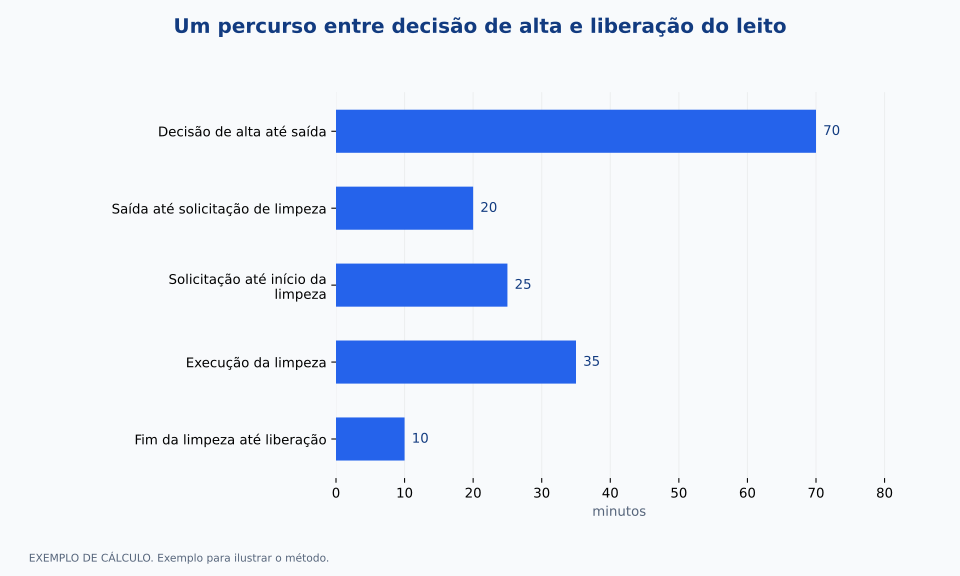
One path from discharge decision to bed release
Sequential path with no overlap: 160 minutes to release. Does not include the next admission and does not set a target.
WORKED EXAMPLEExample to illustrate the method.
Comparison by minutesChange the values to explore a scenario.
In the multidisciplinary review, use the expected discharge as a planning hypothesis, with a date and reason for revision. Identify paperwork, patient education, continuity of care needs, coordination with the care network, and transport, where applicable. For each dependency, record the owner, the next action, and when it will be reassessed. Distinguish what can already be prepared from what depends on clinical confirmation; getting ahead administratively does not justify rushing the clinical decision.
If a diagnostic test is holding up the decision, track its actual sequence: order, required preparation, collection or transport, performance, availability of the result, and review by the responsible team. This breakdown distinguishes equipment unavailability, preparation, the diagnostic queue, and a result not yet reviewed. The classification should describe the dependency observed, without turning every delay into an individual failure.
Cleaning completed and bed released are separate events
Anvisa's manual on surface cleaning and disinfection distinguishes cleaning processes and places terminal cleaning in the context of room vacancy and scheduled routines. It is a technical reference, published in 2010 and still made available by the agency, that must be aligned with local procedures and applicable health regulations. A management turnaround target does not replace these technical conditions. [2]
Record the cleaning request, start, and finish; then confirm the institutional release requirements and any blockers. The Coren-BA opinion (Coren-BA is the Bahia State Nursing Council), revised in 2024 and published in 2025, sets out, in its regional context, the interface between the removal of supplies by nursing and terminal cleaning by the trained environmental services team. It is a regional reference for discussing responsibilities, not a national rule. [4]
Internal transport needs readiness and a confirmed destination
For tests or internal transfers, an operational queue can show the request time, the priority set by the appropriate team, origin, destination, conditions required for the move, and request status. Before dispatch, confirm that both origin and destination are ready according to the service protocol. Recording only that the request was fulfilled hides returns, cancellations, and waits at a unit that cannot yet receive the patient.
Distinguish internal transport from transport out of the hospital, which may involve other providers and access conditions. Assign one identifier per request to avoid duplication and keep the reason for any cancellation. When the clinical situation changes, the appropriate team reassesses the priority and whether the patient can be moved. Tracking locates dependencies without replacing a safety assessment.
Turnover, occupancy, and step times answer different questions
The São Paulo State Department of Health portal brings together metrics for operational beds, occupancy, length of stay, turnover interval, and bed turnover. Its definition of operational beds is based on the daily census, including occupied and vacant beds in operation and excluding blocked beds. This attention to the denominator is essential when capacity changes during the month. [3]
To track turnover, state which discharges are included in the numerator, the period, and how the average number of operational beds is calculated. To find where the process waits, use event timestamps: departure to cleaning request, request to start, execution, and release. Look at the median and 90th percentile of each interval, plus the proportion of records missing a timestamp. The aggregate turnover interval is not the same as the cleaning time for each bed. Do not compare different specialties without considering the care profile and available resources.
Worked example: break it down before choosing an intervention
The chart represents a single example path after the discharge decision: 70 minutes until actual departure, 20 until cleaning is requested, 25 until it starts, 35 of cleaning, and 10 until release. The intervals are sequential and total 160 minutes. The first three steps add up to 115 minutes, but they cannot automatically be classified as avoidable time: the conditions of each transition need to be checked.
The example raises different questions. Did the period before departure depend on patient education, paperwork, or transport? Was the cleaning request late because the system did not receive the event? Was capacity short at peak time? Analysis comes before the solution. These numbers illustrate the method and are not an average, a target, or a benchmark. For a real series, do not add up the medians of each step as if they were necessarily the median of the total path.
Test the reliability of status data before automating follow-ups
Start by reconciling the dashboard with observation on the unit at different times of day. Classify discrepancies and identify who can correct each piece of information. Then test a workflow on one unit: confirmed event, owner notified, completion recorded, and exception reviewed. Once the statuses are understandable and the timestamps reliable, evaluate notifications for agreed delays. Alerts based on wrong data only speed up misdirected follow-ups.
Also examine cleaning rework, reopened blocks, transport cancellations, and reports of patients leaving without adequate discharge education. These signals balance speed and quality. The next step is to bring together the NIR, clinical care, environmental services, diagnostic services, and transport to choose one verifiable dependency and one small change. A lack of capacity or continuity in the care network requires a management decision and external coordination, not just rearranging the colors on the dashboard.
FROM READING TO PRACTICE
Checklist to discuss with your team
Check off the items already in place. Use the rest as a working agenda.
WHAT TO TRACK
Clearly defined indicators
Bed turnover in the period
Eligible hospital discharges ÷ average daily operational beds in the period.
State how discharges, deaths, and external transfers are handled; exclude internal transfers. Daily average = sum of operational bed-days ÷ days. Higher turnover does not prove appropriate discharge.
Operational occupancy (%)
100 × patient-days ÷ operational bed-days in the period. [3]
Keep the census method consistent and make blocked beds explicit.
Time from departure to release
Release time minus actual departure, per episode.
Report the median, 90th percentile, valid episodes, and exclusions. Not the same as cleaning time.
Wait for cleaning to start
Cleaning start minus request, per episode.
Report the median and 90th percentile by shift; investigate readiness and capacity.
Wait for internal transport
Start of transport minus valid request.
Report the median and 90th percentile by priority and destination; identify cancellations.
Status agreement (%)
100 × beds with confirmed status ÷ beds audited.
Fixed criteria and varied times. Proposed data quality metric.
Listen to this article
A conversation in Portuguese on the key points of the article and its references.
Role of the NIR in the patient's journey, coordination between departments, and diagnostic support. Official page consulted live; used as organizational guidance, without reproducing its older legislative links.
Cleaning and disinfection processes, terminal cleaning, and the interface with health services. 2010 manual, consulted live in the official file, without attributing to it a universal turnaround time target.
Concepts of operational beds and operational occupancy, a set of hospital metrics, and the need to consider the care profile. The chart figures are a worked example.
Interface between the removal of clinical supplies by nursing and terminal cleaning by a trained team. Revised in December 2024, published in February 2025; a regional reference, explicitly placed in context.
Educational content on management and technology. It does not replace professional judgment, current regulations or clinical protocols.
We use browser storage to remember your choice and, if you accept, Umami to count visits in aggregate, without cookies and without identifying you. Nothing is used for advertising. Privacy Policy.