Healthcare protocols and training: from the current version to competency
Organize protocols, control versions, and assess healthcare team competencies, with shift-based training, metrics, and a verifiable update workflow.
Tervali Editorial Team7 min read3 sources
THE STARTING POINT
Useful protocols must be findable in their current version and translated into behaviors the team can demonstrate. Training must reach every role and shift, with assessment criteria, protected time, and a record of gaps that remain open.
A newly hired professional receives a file by message, finds a different printed version at the nursing station, and learns a third set of instructions during the shift. The problem involves the document, access, and learning. Publishing a protocol does not ensure that anyone can find it under pressure; recording attendance at a class does not show the ability to perform the task safely either.
Scattered documents, outdated versions, informal onboarding, and training that does not reach every shift are distinct problems and need to be checked at the point of work. The proposed approach connects document governance and competency-based training. It starts with small, verifiable decisions: which version is valid, who the change matters to, how to teach it, and what evidence allows learning to be considered sufficient.
Separate documentation requirements from learning design
RDC 63/2011, an Anvisa regulation on good operating practices for health services, requires written, up-to-date procedures to be accessible to staff. It also requires training before staff begin their activities and on an ongoing basis, with records of date, time, hours, content, instructor, and workers involved. These are operating requirements that must show up in daily routine. [1]
This article proposes methods for putting them into practice, without presenting every method as a legal requirement. A single library, change history, and a competency matrix are management choices. Competency assessment must respect professional roles and the service's technical criteria. Neither an online course nor a signature expands the scope of practice of those who took part.
Start with an inventory and the risk of mismatch
List the documents used in a unit: protocols, standard operating procedures, workflows, forms, and quick reference guides. Record subject, target role, owner, approval, version, and where it is accessed. Look for duplicates by content, since files with different names may guide the same activity. Initial priority should consider the effect of conflicting instructions and frequency of use, rather than relying only on the age of the file.
A long list of expired documents can generate work without fixing the most critical issue. Start by observing a concrete task: does the professional know how to find the applicable guidance? Can they identify the version? Can they find a contact for questions? This test separates missing content, difficulty searching, and instructions that are hard to understand. Each cause calls for a different intervention and a defined owner.
THE PROCESS IN NUMBERS
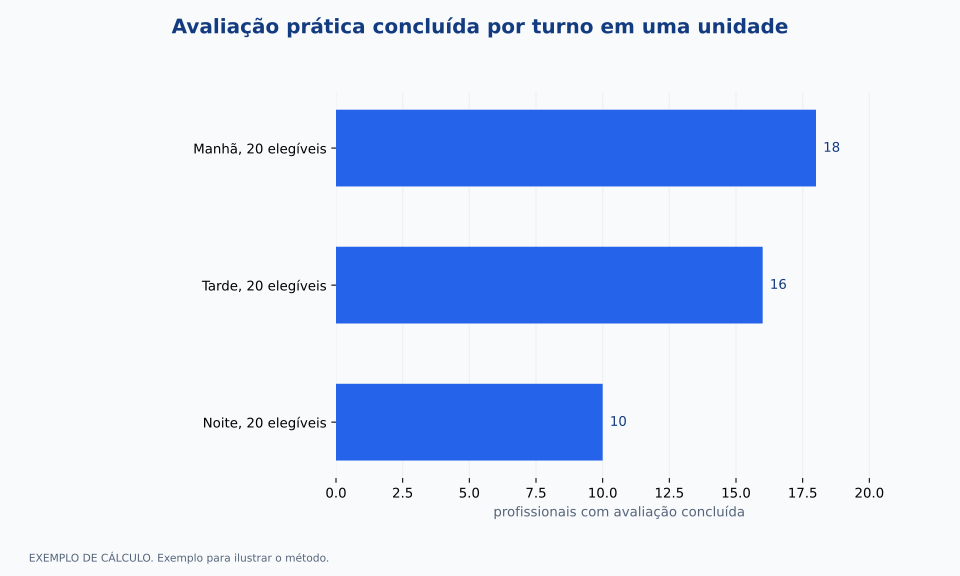
Hands-on assessment completed by shift in one unit
Implementation deadline with 20 eligible professionals per shift: morning 18/20, afternoon 16/20, and night 10/20. Total 44/60. Completion does not mean passing.
WORKED EXAMPLEExample to illustrate the method.
Comparison by professionals with completed assessmentChange the values to explore a scenario.
For each document, consider explicit states: drafting, review, approval, current, and superseded. Define who validates the content and who authorizes publication. A change must show its effective date, a summary of what changed, and the affected audience. The review interval should be chosen based on risk and relevant changes; a universal annual review is not established here as a regulatory requirement.
Use a stable link to open the current version and keep the history restricted to relevant purposes. When a quick reference guide summarizes a protocol, link the two and review both in the same change. Printed copies need identification and a replacement routine. When the system is unavailable, the service must know which controlled copy to use and how to reconcile it afterward, without promoting an old file to a reference out of convenience.
Test lookup using the language of frontline staff
A library organized by administrative structure can still be hard to use. Include terms the team actually uses, synonyms, and filters by activity or department. Check readability on the devices and in the locations available during the shift. A quick-access code helps only if the destination is correct, the device can be used in that setting, and there is an alternative when the network fails.
As a local exercise, ask professionals from different roles and shifts to find a piece of guidance in a simulated situation, with no patient data. Time the search and observe the path chosen, including searches that end on the wrong document. No universal maximum time is proposed. The result is used to compare the same task before and after adjustments, under similar complexity and conditions.
Turn reading into observable behavior
The WHO multi-professional patient safety curriculum guide offers a framework for planning teaching and supporting continuing education across different professions. [2] In the proposed management application, the starting point is to write down what someone should be able to demonstrate after training, instead of listing only the topics covered.
A simple matrix links role, activity, expected competency, reference version, assessment method, and current status. Depending on the risk, a question may check understanding, while a demonstration or simulation allows execution and communication to be examined. Completion should record the criterion used and who assessed it. If there is a gap, define supervision and a new learning opportunity, and avoid treating public exposure of results as an educational strategy.
Plan training around the real schedule
Organize the audience by role, unit, and shift, including temporary and contracted staff who perform the activity. Managers need to plan clinical coverage and participation windows. Asynchronous content can prepare the discussion, but does not by itself address hands-on skills. Duration and format should match the objective; short modules are an option, not a guarantee of learning or a solution to staffing shortages.
Assign facilitators for shifts with less access to the education team and establish how they will deliver the same guidance and the same criteria. Plan make-up sessions for vacations, leaves of absence, and hires between cohorts. Anyone who did not participate remains identifiable as pending, without dropping out of the denominator due to scheduling difficulties. The plan should state what can be done under supervision and who makes that decision in the service.
A new version requires an analysis of its educational impact
When a protocol changes, compare versions and classify the impact on the activity. Wording adjustments may call for a brief communication; a new work sequence or responsibility may require a demonstration and reassessment. These criteria are local proposals and need technical validation. The effective date should consider whether the people, supplies, and access needed to apply the guidance are ready.
The WHO surgical safety checklist implementation manual highlights education, multidisciplinary participation, leadership, and continuous feedback as implementation factors. [3] The lesson for protocol management is to involve those who perform the work before and after the change. Consulting night-shift staff helps identify constraints that a daytime administrative meeting may miss, without assuming that the same solution works in every context.
Read coverage without hiding gaps
Worked example: a unit needs to train 60 professionals on an updated procedure, with 20 eligible on each shift. By the implementation deadline, 18 completed the hands-on assessment on the morning shift, 16 on the afternoon shift, and ten on the night shift. The total is 44 of 60, or 73.3%. The chart shows these counts. The rates by shift are 90%, 80%, and 50%.
The difference calls for investigating access, schedule coverage, and assessor availability. It does not prove lack of interest or lower ability in the night group. Also check whether completion meant only attending or actually demonstrating the defined criteria. To compare different competencies, keep results separate: an aggregate total can mix tasks and levels of difficulty that are not equivalent.
Close the loop with observation and review
After implementation, review samples of use and collect questions. A nonconformity may stem from a hard-to-use document, a missing resource, an ambiguous criterion, or a learning gap. Do not prescribe more training before understanding the barrier. Also, do not automatically attribute an improvement in a clinical metric to the training: changes in staff, demand, and process may have occurred in the same period.
To get started, select a frequently used protocol, remove duplicates from the lookup path, publish the controlled reference, and test the search on every shift. Then apply an assessment proportional to the risk and keep open items with a deadline and an owner. The verifiable result is a team that finds the correct guidance, demonstrates what was defined, and has a path for questions and updates.
FROM READING TO PRACTICE
Checklist to discuss with your team
Check off the items already in place. Use the rest as a working agenda.
WHAT TO TRACK
Clearly defined indicators
Access to the correct guidance
100 × simulated searches ending on the current, applicable document / simulated searches performed, stratified by task and shift.
Also record search time and failures. Compare similar scenarios; quickly finding the wrong document is not a success.
Assessment coverage by shift
100 × eligible professionals who completed the required assessment by the deadline / eligible professionals on that shift at the defined point in time.
Document staff movements, leaves, and replacements. Completing the assessment does not imply passing it.
Demonstrated competency
100 × assessed professionals who met all mandatory criteria / professionals assessed for the same competency and version.
Present alongside coverage and the number pending; a high pass rate with low participation can hide gaps.
Compliance of copies in use
100 × audited access points with the current, applicable version / access points audited in the period.
Include physical and digital media used in daily routine. Describe the sample and do not extrapolate to locations not observed.
FREQUENTLY ASKED QUESTIONS
Questions about this topic
Does signing that you read the protocol prove competency?
The signature records acknowledgment under the terms defined by the service. To demonstrate competency, you need an assessment criterion consistent with the activity and its risk, respecting professional roles.
Do all protocols need an annual review?
Article 51 of RDC 63/2011 requires updating and access, without setting a universal annual interval in that provision. Define reviews based on risk and relevant events, checking any specific applicable regulations. [1]
How can we include the night team without repeating a long class?
Plan facilitators, coverage, asynchronous preparation when useful, and hands-on assessment at accessible times. The format can vary, but the criteria for the same competency must be consistent.
Sources and references
Primary sources used to produce this content. Implementation recommendations should be adapted and validated by each institution.
Articles 31 to 33 and 51: qualification, training, records, and written, up-to-date, accessible procedures; text and in-force status consulted in the official database.
2011 guide, consulted live: planning patient safety education and supporting multi-professional continuing education; does not establish the local targets proposed.
2009 manual, consulted live: participation, leadership, education, training, feedback, and local adaptation in implementing the checklist, used as an implementation reference.
Educational content on management and technology. It does not replace professional judgment, current regulations or clinical protocols.
We use browser storage to remember your choice and, if you accept, Umami to count visits in aggregate, without cookies and without identifying you. Nothing is used for advertising. Privacy Policy.