Surgical cancellations: planning requirements and contingencies
How to organize the surgical schedule, verify patient preparation and supplies, integrate maintenance, and define contingencies with clear metrics and owners.
Tervali Editorial Team6 min read4 sources
THE STARTING POINT
Preventing surgical cancellations starts with confirming each procedure's requirements in advance and identifying open issues with assigned owners. Scheduling, patient preparation, supplies, beds, and maintenance need shared availability criteria and a contingency workflow.
A surgery shows as confirmed on the schedule, but the instruments still need processing, the equipment is under maintenance, and recovery requires a resource that was never reserved. Together, these uncertainties reach the operating room as a delay or a cancellation. The management response starts by distinguishing the intention to schedule from a demonstrated ability to perform the case, without reducing clinical decisions to an administrative list.
Incomplete preparation and unavailable supplies, beds, and equipment are operational hypotheses to investigate when a procedure is canceled, without assuming how often they occur or whether they were avoidable. The proposed method organizes these dependencies, preserves clinical decision-making, and allows teams to learn from failures without turning maintenance or the patient into an automatic explanation.
Define what counts as a cancellation
Before discussing targets, establish the point at which the schedule becomes the reference for the metric. One local option is to take a snapshot of the schedule at the close of the previous day. Procedures removed after that point count as cancellations from that schedule; earlier changes are tracked in a separate measure. This is a proposed management convention that must be documented and applied consistently.
Also record delays, rescheduling, and room changes. For each cancellation, separate the primary reason, contributing factors, and the moment the open issue was identified. Unavailable equipment may be the immediate reason, while the lack of a reservation or of communication was the factor that made the impact unavoidable. Classification requires multidisciplinary review and allows for causes that remain undetermined.
Schedule around each procedure's dependencies
RDC 63/2011, an ANVISA regulation on good operating practices for health services, requires equipment, supplies, consumables, and medications to be available in line with demand and provides for health technology management. This foundation supports the need to organize requirements, without setting a single confirmation window for all surgeries. [1]
For each procedure, link the team, room, estimated duration, instruments, specific supplies, required equipment, and post-surgical destination. Distinguish between a resource that is requested, reserved, and actually available. The expected bed must be confirmed with capacity management at the right time, because an intended discharge is not the same as a vacated bed. Emergencies and clinical changes require an explicit reassessment of the schedule.
THE PROCESS IN NUMBERS
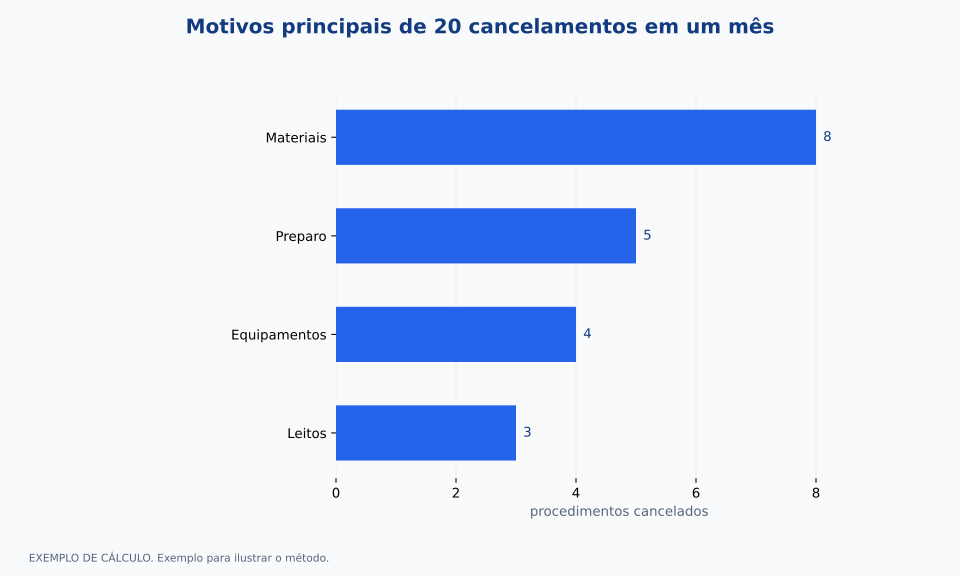
Primary reasons for 20 cancellations in one month
Each cancellation is assigned one primary reason. Supplies: 8/20; preparation: 5/20; equipment: 4/20; beds: 3/20. Counts for discussing prioritization, without inferring national causes.
WORKED EXAMPLEExample to illustrate the method.
Comparison by canceled proceduresChange the values to explore a scenario.
Process map: from scheduling to cancellation review
Process map for discussing responsibilities and handoff points with your teams. Adapt it to your institution’s context.
01
Define requirements
The clinical team and scheduling link needs to the procedure.
02
Confirm resources
Supplies, SPD, beds, and clinical engineering record evidence and constraints.
03
Resolve open issues
The designated owner fixes or escalates before the operational deadline.
04
Decide contingency
Coordination and responsible professionals evaluate an alternative, reordering, or postponement; they return to resource confirmation if anything changes.
05
Perform clinical checks
The team applies the safe surgery protocol at the designated points.
06
Review outcome
Management reviews completion, delay, or cancellation and feeds the findings back into planning.
Define checkpoints proportional to the procedure: one review when the case enters the schedule and another before operational confirmation. These windows are choices made by the service, not universal deadlines. The clinical team defines the applicable clinical requirements; coordination tracks whether they were verified, who owns each open issue, and when the decision must be made. Avoid recording only a ready mark with no author or time.
Communication with the patient should use approved instructions and a channel for answering questions. Confirm receipt and understanding when relevant, taking accessibility and travel barriers into account. If a clinical condition is not met, the decision rests with licensed professionals. Operational consulting does not prescribe preparation, medication holds, or anesthesia criteria. Its role is to keep a known question from staying invisible until the patient arrives in the room.
Treat supplies as resources with deadlines and evidence
Physical stock alone does not demonstrate availability for a case. The proposal is to track quantity, compatibility, integrity, expiration, and release status, in line with the relevant technical procedures. For items that require reprocessing, coordinate the sterile processing department (SPD) with the schedule. For consigned or third-party supplies, record the expected delivery, inspection, and the person responsible for resolving discrepancies.
When two rooms depend on the same instrument set, a double reservation creates fictitious availability. Use a link between case and resource, with an overlap alert and a turnaround time defined by the actual process. If the supply cannot be confirmed, the open issue must reach someone with authority to decide. Last-minute purchasing or borrowing cannot be the only contingency described.
Integrate maintenance and scheduling without assuming release
RDC 509/2021, ANVISA's regulation on health technology management, requires a management plan, systematic records, defined responsibilities, and risk monitoring for the technologies it covers. Equipment must be managed throughout its life cycle, not only when a failure occurs. [2]
As an operational design, connect the clinical engineering inventory to the schedule by equipment identifier. Distinguish between available, reserved, under evaluation, under maintenance, and awaiting technical release. Closing an administrative work order should not automatically be interpreted as clearance for use. The evidence required to return equipment to service depends on the intervention, the technical procedures, and the instructions that apply to that equipment.
Cross-check scheduled maintenance against the procedures that depend on that resource before closing the schedule. In a contingency, confirm whether an alternative has compatible capacity, accessories, and qualified staff. A device located in another unit may already be committed to other patient care. The decision to reassign it must consider that impact and have an identified owner, especially outside business hours.
Preserve the purpose of the surgical safety checklist
The Brazilian national protocol describes the checklist at three points: before induction of anesthesia, before skin incision, and before the patient leaves the operating room. It also addresses equipment condition and team communication. Advance verification of resources should complement these safeguards while preserving the check at the point of care. [3]
Implementation requires team participation and feedback on practice. The WHO manual highlights local leadership, education, multidisciplinary involvement, and adaptation to context. [4] In the approach proposed here, the advance review identifies logistical obstacles; the surgical checklist keeps its clinical purpose. Filling in a screen ahead of time does not prove that the safety conversation took place in the room.
Decide the contingency and record the effect on the patient
Each critical open issue should have a path: fix it by the agreed deadline, replace it with a technically validated alternative, reorder the schedule, or escalate the postponement to the responsible decision-maker. Record who decides, who will be informed, and what information goes into the shift handoff. An emergency may call for a different priority, but that choice does not justify ignoring safety or availability requirements.
Worked example: in one month, 20 procedures were canceled after the schedule closed. Each event was assigned a primary reason: eight for supplies, five for preparation, four for equipment, and three for beds. The breakdown suggests where to start the investigation, without demonstrating avoidability or the effect of an intervention.
Test the workflow on a defined schedule
Start with one specialty or set of rooms and keep an open-issues log with owner, deadline, evidence, and decision. Bring together scheduling, nursing, the medical team, supplies, bed management, and clinical engineering to examine a few complete cases. Look for the first opportunity when information could have changed the outcome, without assuming the unit where the problem surfaced is to blame.
Compare periods using the same schedule definition and report volume, procedure mix, and emergencies. Lowering the rate by removing difficult cases before the cutoff may simply shift the problem. For that reason, also track wait time until rescheduling, changes made before the schedule closes, and repeat cancellations. The next verifiable step is to show that every critical open issue had a recorded decision before the time planned for the procedure.
FROM READING TO PRACTICE
Checklist to discuss with your team
Check off the items already in place. Use the rest as a working agenda.
WHAT TO TRACK
Clearly defined indicators
Cancellation after schedule close
100 × procedures canceled after the defined cutoff / procedures in the schedule snapshot at that cutoff, in the period.
Report counts, the cutoff, and exclusions. Separate emergencies added later and track changes made before the cutoff.
Critical open issues resolved on time
100 × critical open issues with documented resolution by the agreed deadline / critical open issues due in the period.
Also track the number of cases with open issues; late entries can distort the result.
Impact of equipment unavailability
Number of canceled procedures with equipment as the primary reason and number with equipment as a contributing factor, in separate series.
Do not add the two series without deduplication. Confirm the link to the equipment and review the cause.
Wait time to rescheduling
Median and 90th percentile of days between cancellation and completion of the procedure, by cancellation cohort.
Also report how many cases remain unperformed; silently excluding them flatters the result.
FREQUENTLY ASKED QUESTIONS
Questions about this topic
What is an acceptable surgical cancellation rate?
This article does not set a universal target. Use a stable definition, stratify the schedule mix, and analyze safety, access, and causes before setting local goals.
Does the surgical safety checklist replace advance confirmation?
No. The national protocol calls for checks at specific points of care. Advance confirmation organizes logistical dependencies and must coexist with those safeguards. [3]
Is every equipment-related cancellation avoidable?
That cannot be concluded from the recorded reason alone. Investigate the failure, technical condition, maintenance, reservation, alternatives, and timing of communication before classifying avoidability.
Sources and references
Primary sources used to produce this content. Implementation recommendations should be adapted and validated by each institution.
2009 manual consulted live: leadership, training, multidisciplinary participation, feedback, and local adaptation, without extrapolating to cancellation rates.
Educational content on management and technology. It does not replace professional judgment, current regulations or clinical protocols.
We use browser storage to remember your choice and, if you accept, Umami to count visits in aggregate, without cookies and without identifying you. Nothing is used for advertising. Privacy Policy.