Clinical inventory: traceability to restock, locate, and control expiration
How to organize clinical inventory by lot, expiration date, and location, set restocking levels, and measure stockouts, losses, and search time in hospital units.
Tervali Editorial Team7 min read3 sources
THE STARTING POINT
Clinical inventory needs to show what can be used, where it is, and when it should be restocked. Tracking receipts, transfers, consumption, and returns makes it possible to investigate shortages and expirations without confusing the book balance with real availability.
A unit requests wound care supplies that show up in the system, but no one can find them. In another cabinet, units of the same item are approaching expiration. Together, these reveal two separate questions: is there enough quantity, and is that quantity accessible, identified, and fit for use? Buying more may temporarily address the first question and worsen the second.
This article proposes an operational method for tackling time spent searching for supplies and equipment and the imbalance between shortage, excess, and expiration. The formulas and pilot described are management proposals to be adapted with supply chain, nursing, pharmacy, and clinical engineering. They do not represent an assessment of any specific hospital and do not replace technical decisions about products and care.
Define availability before designing the dashboard
Separate physical stock, reserved quantity, blocked items, and the balance actually available. A product in quarantine or with compromised packaging should not appear as an option for patient care just because it is still among the hospital's assets. The useful view for the unit combines item code, presentation, usable quantity, storage location, and time of the last update.
Consumables and mobile equipment require different records. For a gauze pad, track lot, expiration, and unit of use; for a wheelchair, individual identification, location, and operational status. An infusion pump may have been located and still require cleaning, maintenance, or technical release. Avoid a single field called available that hides these conditions.
Make the item master reflect real work
Start with the items that cause interruptions or losses, using a record approved by the responsible areas. Capture an unambiguous description, purchasing unit, distribution unit, conversion between package sizes, and authorized locations. Boxes and individual units cannot share a balance without an explicit conversion. Similar descriptions also need review to avoid duplicate records and picking errors.
The Ebserh quality manual (Ebserh is the federal company that manages Brazil's university hospitals) offers an institutional reference for inventory control, expiration, and losses; its requirements should be interpreted in the context of that network, without automatically turning them into a universal obligation. [1] As an implementation proposal, test the item master with the people who receive goods and the people who pick them: if two people interpret the presentation differently, the item master is not ready yet.
THE PROCESS IN NUMBERS
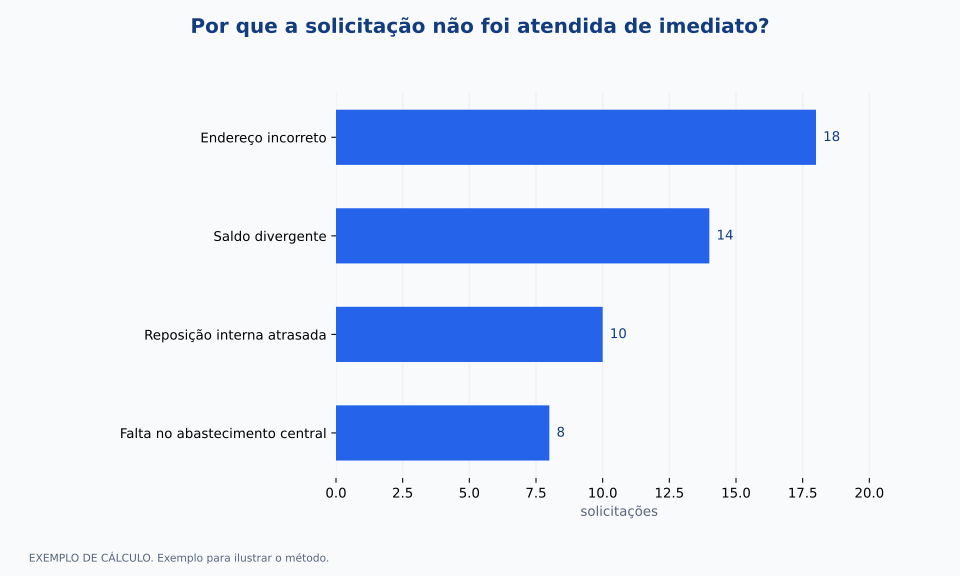
Why wasn't the request fulfilled immediately?
Example week, 50 request lines not fulfilled immediately; one primary cause per line, with no overlap. The values add up to 50 and do not represent prevalence or the result of an intervention.
WORKED EXAMPLEExample to illustrate the method.
Comparison by requestsChange the values to explore a scenario.
Each movement must specify item, quantity, origin, destination, person responsible, and time. Add lot and expiration where applicable. A transfer to a clinical supply cabinet changes where the stock is located; it does not prove the supply was used. If the institution records that issue as consumption for administrative purposes, document the limitation before estimating consumption per procedure.
The WHO recommends governance, financial sustainability, and identification and data exchange standards when structuring traceability of medical products. [2] A local application of this principle is defining which system is the source of record for each event. Duplicating the same issue in a spreadsheet and in the ERP creates two competing balances; an integration must reconcile confirmations, failures, and repeated entries.
Manage expiration with an action and an owner
Adopt an operational queue of products nearing expiration, sorted by date and by the possibility of authorized use. The FEFO approach, first expired, first out, only works when physical picking and the selection in the system follow the same lot. An alert without a recipient only changes where the backlog piles up.
For each alert, record a decision: keep the planned consumption, evaluate a permitted transfer, handle a contractual return, or send the loss to the institutional workflow. Compare the quantity that will expire with plausible demand before that date. Do not transfer items just to remove the risk from a local report, and do not automatically replace every product removed due to expiration: the stock level may be overstated.
Calculate restocking without treating the average as a guarantee
An initial reorder point can combine average daily consumption multiplied by the replenishment lead time and a safety stock set according to variability and criticality. For the unit cabinet, use the internal delivery time. For hospital purchasing, consider the full lead time until the product is accepted and available, including receiving and any required checks.
Worked example: consumption of 12 units per day, internal delivery in two days, and a safety stock of 18 units produce an initial reorder point of 42 units. These numbers are not a minimum stock recommendation. Reassess the assumption against delays, peaks, and storage capacity. Stockout days can artificially lower observed consumption: unmet demand needs to be recorded separately.
Use barcodes with a consistent identity
Anvisa's current page on UDI states that SIUD, Brazil's unique device identification system, has been in operation since March 2026 and sets out obligations with phased implementation. UDI identifies devices and supports surveillance activities; it is not the same as an automatic record of location or consumption inside the hospital. [3] Applicability must be checked by device and obligation, without assuming that all supplies already follow the same standard.
In the practice proposed here, the scanner must recognize the product, presentation, and available production information, and link them to the institutional item master. Internal labels must preserve the link to the original identification. Test scans on the packaging staff actually use, and define how to record illegible labels, split packages, and downtime without a scanner. The technology loses its value if the exception ends up as a note that is never reconciled.
Read the chart as an investigation queue
The chart shows an example of 50 requests that were not fulfilled immediately in one week: 18 due to an incorrect location, 14 due to a balance discrepancy, 10 due to delayed internal restocking, and 8 due to a shortage in central supply. Each request was assigned one primary cause.
In this example, buying more would not directly address the first three categories. Before deciding, it would be necessary to verify whether the causes were classified with consistent criteria and whether there are secondary causes. Do not use the proportions as a national estimate. The purpose of the chart is to show how to separate a location failure, a recording failure, and insufficient supply in order to choose a verifiable intervention.
Measure fulfillment and losses with clear denominators
Define a request as one requested line item, with an agreed quantity and deadline. A partial delivery does not count as full fulfillment. Record both the time to first delivery and the time to completion, so that a small delivery does not hide the outstanding balance. Emergency purchases also need a stable reason and classification.
Analyze stockouts and expiration losses together with average inventory and time spent searching for supplies. Fewer losses may result from lower stock, but also from incomplete write-offs; fewer requests may indicate that staff have stopped bothering to report shortages. Stratify by item, unit, and shift before comparing teams. The metrics below are proposed operational definitions, with no universal targets or promise of savings.
Test a complete cycle before expanding
Select one unit and a small group of supplies, covering receiving, storage, requests, restocking, consumption, and returns. Establish a baseline with a physical count and observation across shifts. Agree on who corrects the item master, who handles discrepancies, and who approves changes to stock levels. Include the staff who search for the items in the review of storage locations.
During the pilot, simulate a loss of connectivity, a transfer between units, and the discovery of an expired lot. Then compare records with physical evidence and examine the additional effort for the team. Only expand once movements can be reliably reconstructed and decisions on exceptions are documented. The next useful step is to deliver a list of confirmed problems and their causes, before choosing new tools.
FROM READING TO PRACTICE
Checklist to discuss with your team
Check off the items already in place. Use the rest as a working agenda.
WHAT TO TRACK
Clearly defined indicators
Full fulfillment on time
Request lines fully delivered by the agreed deadline / total lines with a deadline that ended in the period × 100.
Partial deliveries and lines still incomplete after the deadline stay in the denominator and out of the numerator.
Stockouts of monitored items
Item-day pairs with zero available balance / total item-day pairs tracked in the period × 100.
Define the items, units, and time of the check in advance; a zero balance alone does not measure unmet demand.
Expiration loss by value
Value of write-offs due to expiration in the month / value of average daily inventory for the same scope in the month × 100.
Use the same cost basis and disclose absolute values; the metric is unstable when average inventory is small.
Search time
Median minutes between the start of the search and locating the item in observed searches; also report the 90th percentile and the number of observations.
Record searches where the item was not found and the observation method separately; do not exclude them silently.
FREQUENTLY ASKED QUESTIONS
Questions about this topic
Do barcodes solve supply shortages?
They help identify and record events when the item master, scanners, and routines work. On their own, they do not fix supplier delays, inadequate stock levels, or storage without assigned locations.
Does every unit need to be tracked individually?
It depends on the product, the risk, and the purpose. Lot and expiration may be enough for consumables; mobile equipment requires individual identification. The level of detail should be defined with the technical leads.
Should every item near expiration be transferred?
No. A transfer depends on real need, storage conditions, integrity, transport, and institutional rules. The decision must avoid simply shifting the loss to another unit.
Sources and references
Primary sources used to produce this content. Implementation recommendations should be adapted and validated by each institution.
We use browser storage to remember your choice and, if you accept, Umami to count visits in aggregate, without cookies and without identifying you. Nothing is used for advertising. Privacy Policy.